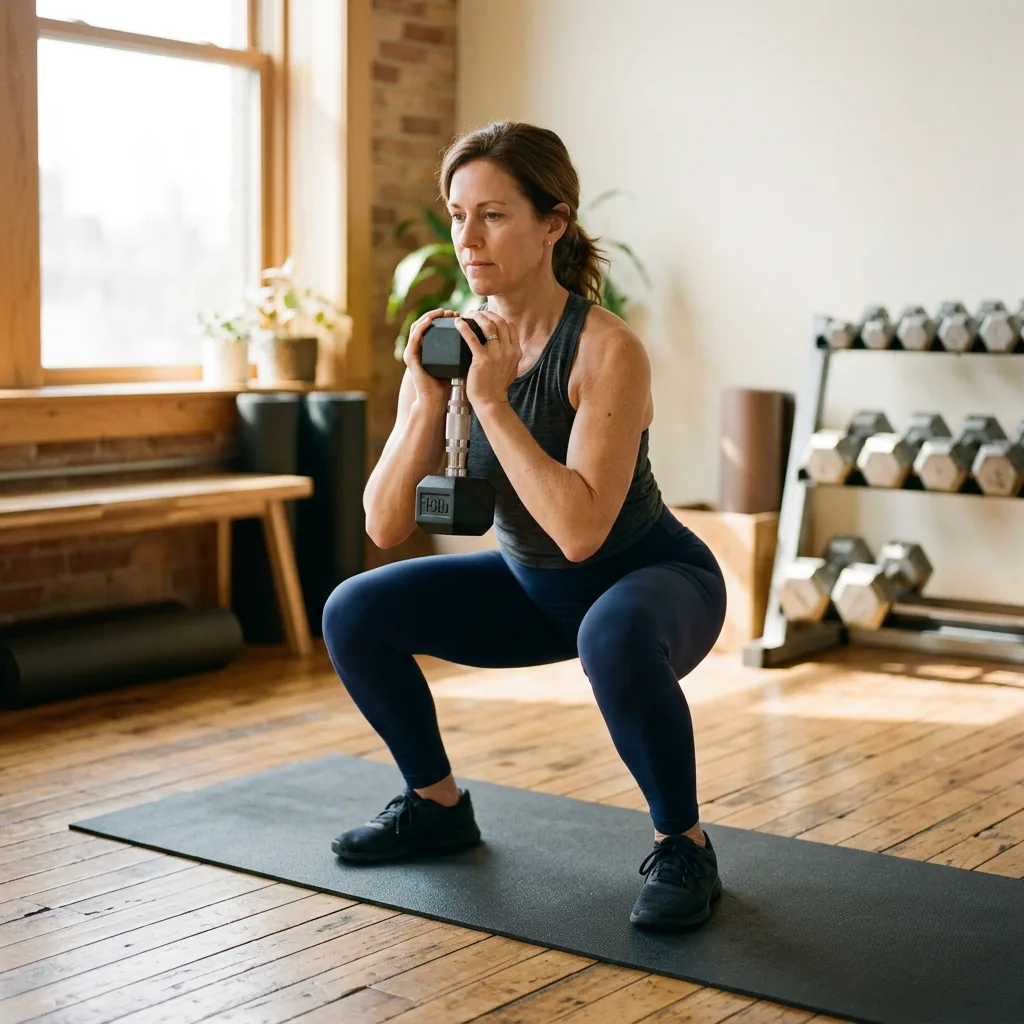
If your knees, hips, or back complain every time you try to get back in shape, this article is for you. We train a lot of people at our Lakeview studio who came to us convinced that losing weight had to mean jumping, pounding, and hobbling around sore for days. It doesn’t. Some of our best transformations have come from people who never did a single burpee.
Low impact does not mean low results. It means training in a way your joints can handle today, so you can still be training six months from now. And six months of consistent work beats six weeks of punishment followed by a quit, every single time.
Here is what actually works, in the order we would prioritize it for most people.
What “low impact” actually means
Low impact simply means at least one foot stays on the ground, or your body is supported by something like a bike seat, the water, or a rowing machine. No jumping, no pounding.
People often confuse impact with intensity. They are not the same thing. A set of slow goblet squats can leave you breathing harder than a round of jumping jacks, with a fraction of the stress on your knees. You can work very hard, and get very real results, while staying gentle on your joints.
That distinction matters most for the people we see every week: adults over 40, beginners starting from zero, anyone carrying extra weight that makes jumping uncomfortable, and people coming back from an injury. For all of them, low impact is not the consolation prize. It is the smarter plan.
Why low impact training works so well for weight loss
Weight loss comes down to burning more energy than you take in, repeated over months. The workout that helps you do that is the one you can actually repeat. High impact training has a sneaky way of interrupting consistency: sore knees turn into skipped sessions, skipped sessions turn into lost momentum.
The general target for health and weight management, per the CDC’s activity guidelines, is 150 to 300 minutes of moderate activity a week plus at least two days of muscle strengthening. Notice that nothing in that recommendation requires impact. Every minute of it can be done with your feet on the ground.
Now the ranking.
1. Strength training (the one most people skip)
If you only change one thing about your routine, make it this. Strength training is low impact by nature when it is programmed sensibly: controlled tempos, machines, cables, dumbbells, and bodyweight movements that never ask you to leave the ground.
It also protects the thing most diets destroy. When people lose weight through cutting calories alone, a chunk of what they lose is muscle. Research, including a large meta-analysis in Obesity Reviews, shows that lifting while you lose weight helps you hold on to muscle and lose more of what you actually want to lose, which is fat. More muscle also means a body that burns more energy at rest and looks noticeably different at the same scale weight.
This is the backbone of how we train clients for fat loss at Transform. Our sessions are 30 minutes of focused strength work, no wasted time, which is exactly the format busy people stick with. You can see what that looks like on our studio services page.
A simple starting template: squat or leg press, a push (chest press or incline push-up), a pull (row or lat pulldown), a hinge (Romanian deadlift or hip bridge), and a carry or core move. Two to three rounds, twice or three times a week.
2. Walking, especially incline walking
Walking is the most underrated fat loss tool in existence. It burns a meaningful number of calories, requires zero recovery, and you can do it every single day. According to Harvard Health’s calorie tables, a brisk walk burns roughly 250 to 350 calories an hour depending on your size, and cranking the treadmill incline pushes that higher without adding any impact.
Living in Chicago gives you one of the best walking routes in the country. From Lakeview, the Lakefront Trail is minutes away, and a 45-minute walk along the water does not feel like exercise at all. In winter, an incline treadmill does the same job.
Our usual prescription: a daily step target, built up gradually. Someone at 4,000 steps a day moves to 6,000, then 8,000. Nothing dramatic, hugely effective.
3. Cycling and the stationary bike
The bike supports your body weight completely, which makes it one of the friendliest options for cranky knees, with one caveat: set the seat height correctly. Moderate cycling burns in the range of 400 to 600 calories an hour for most people, and the stationary version removes every excuse Chicago weather can invent.
The bike is also our favorite tool for low impact intervals. Eight rounds of 30 seconds hard, 90 seconds easy, gets your heart rate into serious territory with zero pounding. If you miss the feeling of an intense workout, this scratches that itch safely.
4. Swimming and water workouts
Water removes almost all impact, which is why we point clients with arthritis, significant joint pain, or a lot of weight to lose toward the pool. Moderate lap swimming burns roughly 350 to 500 calories an hour, and water walking or aqua classes are legitimate options for beginners who find lap swimming intimidating.
The honest downside: access. You need a pool, and Chicago park district lap lanes fill up. If swimming fits your life, it is excellent. If getting to a pool adds friction that makes you skip workouts, choose something you can do anywhere.
5. Rowing
The rowing machine works your legs, back, and arms in one motion, keeps you fully supported the entire time, and rewards smooth technique over brute force. It burns calories at a rate comparable to cycling and doubles as light back strengthening, which most desk workers badly need.
Form matters more here than on any other machine on this list: legs push first, then the body leans back, then the arms pull. Most people do it backwards. Ten minutes of coaching fixes it for good.
A sample low impact week
Here is how we would put it together for a typical client who wants to lose weight without joint pain. Total structured time: about two and a half hours a week.
- Monday: 30 minutes of full-body strength training
- Tuesday: 45-minute brisk walk, outside or on an incline treadmill
- Wednesday: 30 minutes of full-body strength training
- Thursday: rest, or an easy 20-minute walk
- Friday: 30 minutes of full-body strength training
- Saturday: 30 minutes on the bike, steady or intervals, or a swim
- Sunday: completely off, or a relaxed walk along the lake
Hit a daily step target underneath all of it, keep your nutrition pointed in the right direction, and that schedule loses fat reliably. Not crash-diet fast, but steadily, and without the injuries that end most fat loss attempts.
If you would rather have someone build this around your body, your schedule, and whatever your joints are dealing with, that is exactly what we do. Your first session at our studio is free: an in-depth consultation where a trainer assesses where you are and starts building your plan with you.
The mistakes that stall low impact weight loss
After years of coaching this, the same four mistakes show up over and over.
Doing cardio only. Walking and cycling burn calories during the workout. Strength training changes what your body does the other 23 hours. You want both, and if you can only do one, lift.
Confusing gentle with easy. Low impact protects your joints. It should still challenge your muscles and your lungs. If your walk never gets brisk and your weights never get heavier, progress stalls.
Chasing soreness. Soreness is not the goal and never was. Some of the most productive sessions leave you feeling worked but fine the next day. Judge your program by your measurements, your strength, and your energy, not by how much pain you are in.
Going alone without a plan. Random workouts produce random results. A structured plan that progresses a little each week is what separates people who lose 20 pounds from people who lose the same 5 pounds every January.
You do not have to beat yourself up to lose weight
Almost every client in our success stories had tried the punishing version of fitness first. Boot camps, running on bad knees, programs built for 25-year-old athletes. What finally worked was the boring-sounding alternative: strength training a few times a week, lots of walking, food handled, repeated for months.
That is the whole secret. Low impact workouts for weight loss are not the slow lane. For most adults, they are the only lane that actually reaches the destination.